- BelagoLa – Meaning White Pond. goLa – derived from KoLa. The pond is near Janardhana Temple
- A very fertile land in Kaveri area. Barrages were built by Cholas and Hoysalas across Kaveri.
- Cholas established the Belagola Sthala – a Chaturvedi Mangala. Settlement of Brahmins. Due to Cholas rule in South of Kaveri, this area came under influence of Tamil culture
- The Mangalam resulted in construction of 3 prominent temples in 11th Century:
- Agastyeshvara Temple in Balamuri
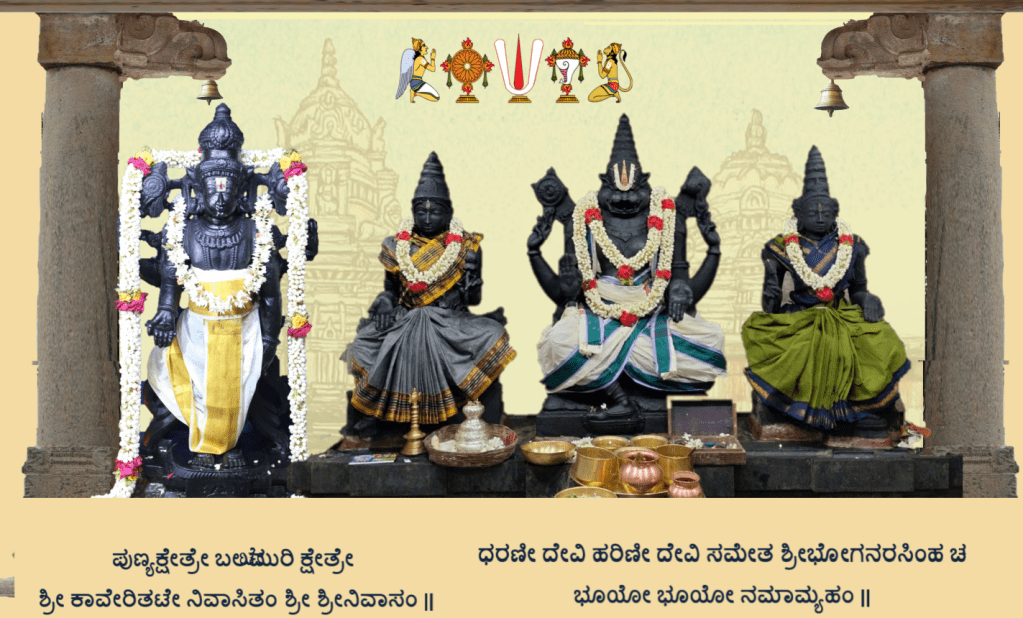
- Srinivasa Temple in Srinivasa Kshetra
- Janardhana Temple in Belagola town
- Srinivasa Temple, fulfilled the needs of an Agrahara and riverside pilgrim place for Vaishnavas (just as Agastyeshvara temple for Shaivites)
- Cholas were expelled by Hoysalas in 1115AD. Chaturvedi Mangalam then became Kongu Konda Vishnuvardhana Poysaladeva Chaturvedi Mangalam
- Belagola continued to flourish. However, construction of more barrages and subsequently KRS Dam forced migration of people to elevated areas
- 11th Century AD : Cholas period Vaishnavas built the Srinivas Shrine with a Malika around it which served as a Pradakshina patha. It had entrances from South and East.
- 12th Century AD : Main sculpture of Srinivasa was probably replaced when Hoysalas took over – replaced by the current vigraha that has the stamp of Vijayanagara style and intricate work
- 12th / 13th Century AD : Narasimha Shrine came up. It had 20 Padmas in 5 rows of 4 each on the ceiling with the tower in Dravidian mode, with domical Shikara and no Stucco sculptures on the Vimana. Both shrines had Vaishnava dwarapalakas
- 13th Century AD : Malika got damaged. Pillars from here were reused by Hoysalas to build a pillared assembly hall in front of the Shrines. South and East entrances were retained.
- 17th Century AD : Wodeyars renovated the shrines
- Porches came up on eastern and southern sides
- Utsava Mantapa on north western side
- 18th / 19th Century AD : Steps leading to the river built as a service by one lady Nanjamma of Varanasi
- 19th Century AD : under patronage of Wodeyars, additional structures came up
- A Pakashala against southern wall
- Srimatha against northern wall
- A brick and mortar compound wall with North entrance thru proper dwara mantapa and South entrance thru a simple stone frame and lintel
Source:
Srinivasa Kshetra – Antiquity and Architectural Remains
Dr. M.S. Krishna Murthy, Former Professor and Chairman, UGC Emeritus Fellow DoS in Ancient History and Archaeology. University of Mysore, Mysore, INDIA
- 2008 to 2023 AD : renovation of the main shrines and assembly hall walls were done. Compound wall reconstructed with a new main entrance on East side and a small gate on the South.
- Works on Pakashala, Utsava Mantapa and Srimatha are deferred. North gate is not yet opened. Steps leading to the river too are not yet rebuilt.
Elders in the community with Srinivasa as family deity believe that the moola vigraha of Sri Srinivasa was once taken from Kaveri banks to Sri Sampige Srinivasa temple, Thuruvekere, Tumakuru, and was brought back to re-establish the shrine in Sri Srinivasa Kshetra sometime in 17th /18th Century.
 Sri Srinivasa Kshetra
Leave a Reply