Over the years …
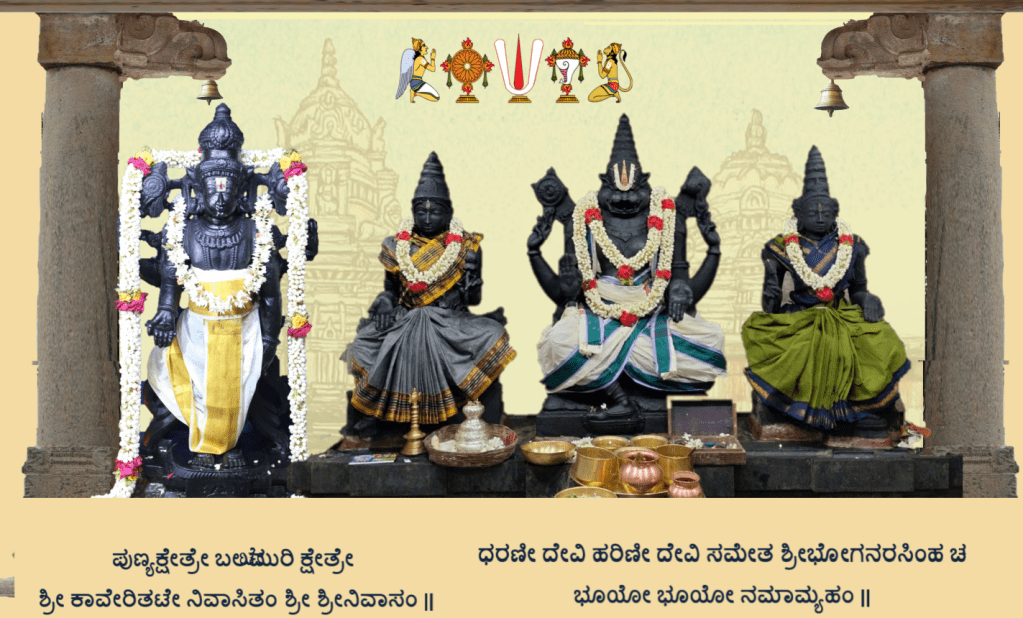
Srinivasa kshetra is located on the serene southern banks of the pristine river Kāvēri in the village of Balamuri, about 20 kms from Mysore and 150 Kms from Bangalore. The principal deity of the shrine is Lord Srinivasa.
The real anecdotes of the temple is shrouded in history but there is no doubt about its antiquity. Archaeological evidence indicates that the temple is at least 1,000 years old. It certainly had a glorious and prosperous past as evidenced by the sheer beauty of the vigrahas. It even enjoyed the patronage of the benevolent Maharajahs of erstwhile Mysore dynasty and several other influential Srivaishnavaite families. During these times, the temple even underwent an expansion and another sannidhi for Bhoga Narasimha with Bhudevi and Sridevi came up within the precincts of the same temple.
However, the temple lacked a dedicated administrative infrastructure. With passage of time, the patronage reduced to a trickle and with little or no maintenance, the temple started to decay. The ramparts of the temple fell apart and with no security and reduced footfall, it fell into the hands of miscreants. Several idols and many valuables were lost. The temple became a hideout for thieves and antisocial elements.
The silver lining in the dark clouds came in the form of Orissa Association of Mysore (OAM) and renewed efforts of some dedicated Srivaishnavaites from Bengaluru and elsewhere. It was a herculean effort to free the temple from the antiquated cobwebs of the district administration. The footfall gradually increased and a sustainable daily pooja routine took shape. Today the system is more established and vibrant due to the benevolent association of Shree Lakshmi Narasimha Kshetram, a vedic institution in Belagola.
The gentle and pristine river Kāvēri is the only repository of all the secrets and history of this sacred shrine. The surrounding endless greenery and the gentle cool breeze, uneffected by city pollution and chaos, has a calming influence on the stressed minds of devotees and visitors alike. If you are in Bengaluru or Mysuru or nearabouts, make sure you do not miss this shrine. There’s a lot it can give and there’s a lot you can contribute too by way of donations and services.
S Srikanth
Inception (11th century)
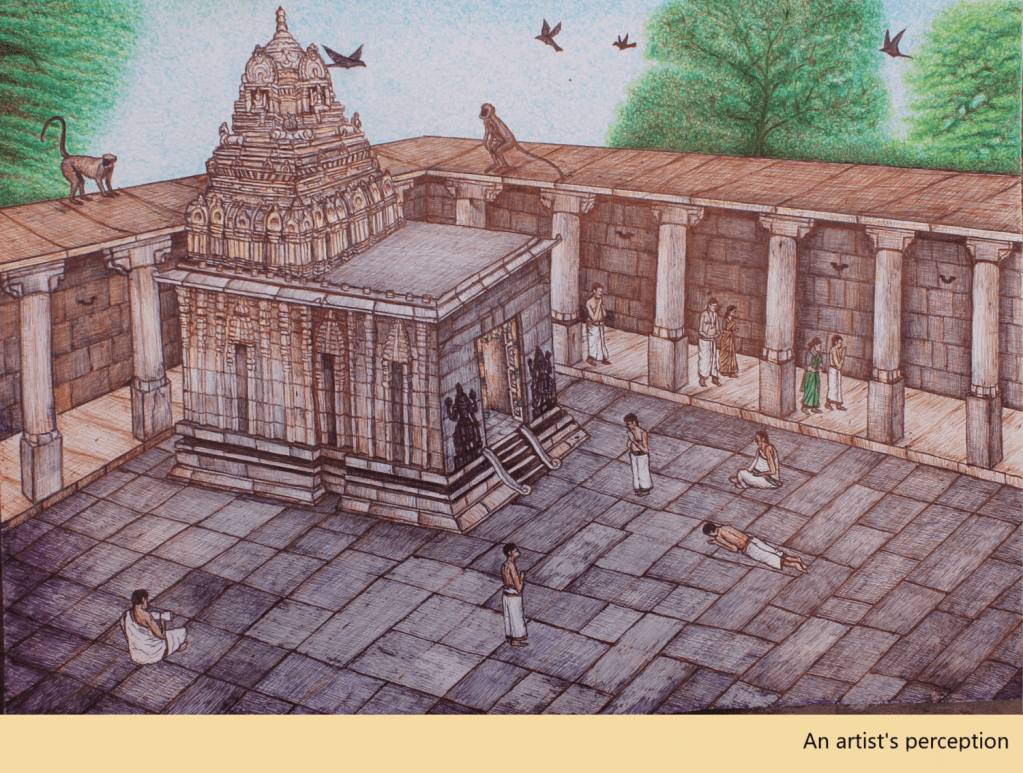
At its inception, the Kshetra consisted of only the Sri Srinivasa temple. The temple was surrounded by a pradakshina patha (pillared corridor) built around the sannidhi.
The south-facing Sri Bhoga Narasimha sannidhi is estimated to have come up later during the rule of Hoysalas as an extension after clearing the pradakshina patha which was in a dilapidated condition.
The serenely located Kshetra on the banks of Kāvēri became a prominent pilgrimage place for Sri Vaishnavas.
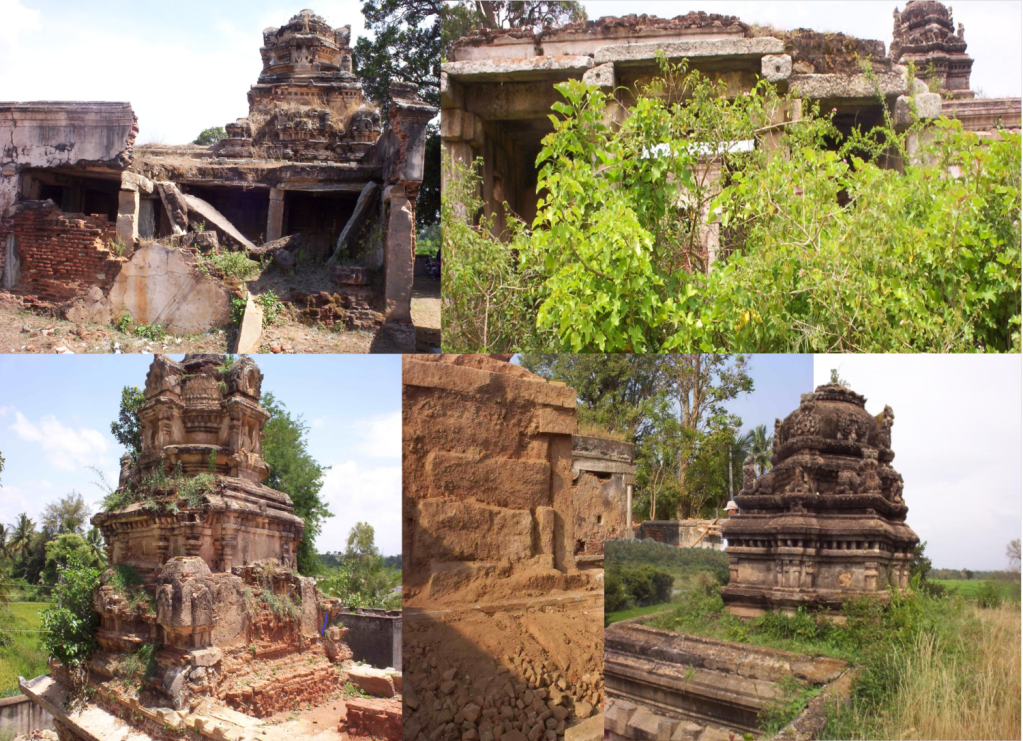
The dilapidated corridor was cleared and a common mantapam was constructed reusing the pillars from the corridor. However, ravages of time and migration of patrons to faraway places took its toll and by 19th century, the Kshetra went into a decline.
Condition as in 2003
The advent of Wodeyars of Mysuru and prominent Srivaishnavas of the region resulted in the renovation work yet again. They spruced up the premises with beautiful porches in front of the shrines. They also constructed a Pakashala and Sri Matha. The river side was also developed further by building a sopanam from the temple boundary to the river waters to facilitate pilgrims take a dip in river Kāvēri.
Renovation (2005-2022)
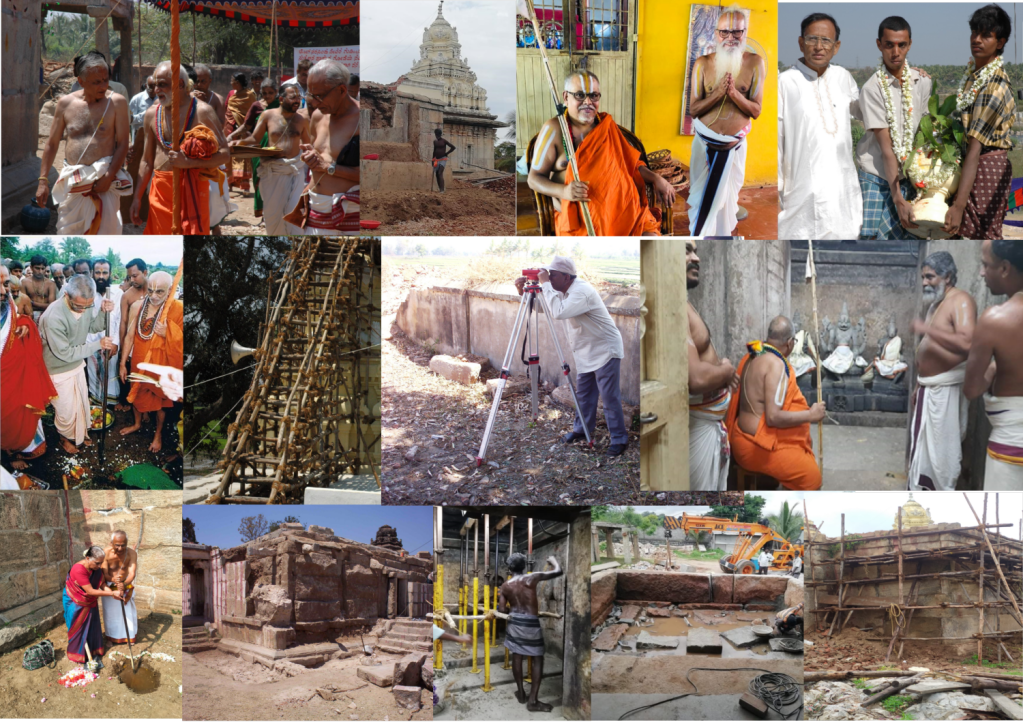
After active Wodeyar rule, yet again, communal and political scenarios in the region forced mass migration of patrons to far off regions resulting in poor maintenance and neglect of the temple. By late 20th century, the temple became completely dilapidated. However, as discovered in 2003, Murthis of Srinivasa, Narasimha, Sridevi and Bhudevi were in immaculate condition. All other murthis of Alwars, Garuda were lost. Much of temple property was usurped. The location became a favourite grazing place for cows.
In August 2003, OAM President Sri D K Misra and some members of the organization had gone to the banks of river Kāvēri on Srinivasa Kshetra road to immerse a Ganesh idol. While returning they noticed the temple in a dilapidated condition. The team made an instant decision to initiate actions for restoration and renovation of the temple and worship of the presiding deities.
After a year of persuasion with Govt of Karnataka, OAM was granted permission to renovate the temple. Partial renovation was completed and Prana Pratishta was performed on 14th April 2005. Subsequently an archaka was appointed for performing regular pujas.
Patrons from Bangalore and far off places started visiting and contributing essential items for worship. However, repeated burglaries hindered regular rituals. A high rise compound wall was built and secure gates were installed in the year 2011.
Samprokshanam (2008, 2022)
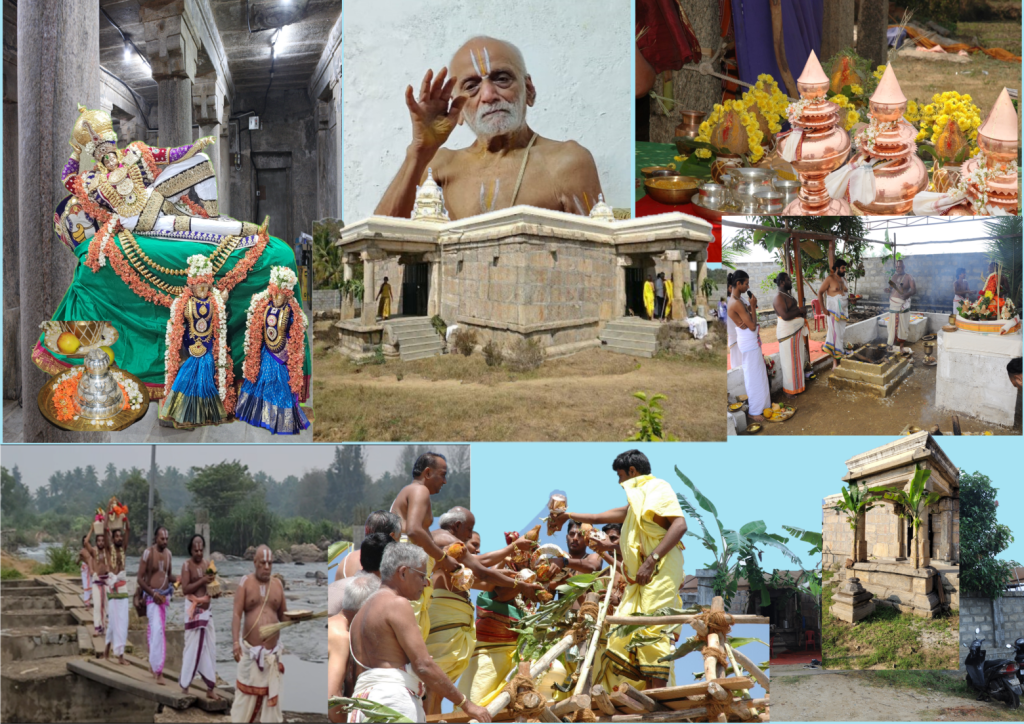
Due to paucity of funds, renovation of Sri Bhoga Narasimha sannidhi had to be deferred and was taken up in March 2022. After completion , Samprokshana was done on 13th November 2022.
Upon specific request, Shree Lakshmi Narasimha Kshetra (Parashara Gurukulam) appointed an archaka and even deputed security guards for the temple. Thanks to their dedication, Nitya Pujas and regular sevas as per Agama shastras are continuing in the temple.
S Srinidhi
Orissa Association of Mysore
Orissa Association of Mysore is a non-profit socio-cultural organization established in Mysuru in 1993.
For more information on OAM, please follow the links below:
* Website
* Facebook
* In the News
Anant Gopinath
Sri Srinivasa Kshetra has a long history of association with SriVaishnavaite families, going back to the times of Wodeyar kings of Mysuru and probably much before. The descendants of these families have several interesting tales and anecdotes connecting them to the temple.
Smt. Sharada Rangaswamy, 93, recollects the association of her ancestors with the temple. During the early late 19th century, Sri Ramanuja Iyengar, a medical practitioner at Mysuru Palace, through his connections, was instrumental in securing the patronage of the Royal family for the temple. Palace Ramanuja Iyengar, as he came to be known, and his family members did yeomen service to the temple. During this time the temple was also granted with large stretches of agricultural lands by the Mysuru Royalty. Beautiful porches were built at the temple. Bathing steps towards the river also came up during this time.
The gainful patronage continued down generations. However, with many families migrating to other parts of the country and with dwindling footfall, the temple sadly went on a downward spiral. Lack of security and with no regular worship, most valuables vanished from the temple. By mid 1950s, the temple had gone to a state of utter ruin. With no proper roads to connect it with neighboring villages and no lights and electricity, the devotees, far and few of them, faced lot of difficulties to even plan a visit. They had to trek 20-25 Kms on foot or by bullock cart, carry their own puja samagri, utensils and firewood for cooking their food on the way or near the temple precincts braving possible encounters with robbers and wild animals alike.
The advent of OAM was a divine gift from the Lord. Fortuitously, the OAM president Sri Dilip Kumar Misra and a few likeminded people, who were returning after Ganesh nimmanjan in the nearby river Kāvēri, noticed the dilapidated temple and decided to take up restoration work. This was definitely a divine intervention!
So started the association of OAM with the SriVaishnavaite families lead by Sri Anantharam, Sri RYN Iyengar, Smt Sharada Rangaswamy to name a few. With renewed patronage and concerted efforts from the subsequent generations, notably Balaji, Kamala and several others, significant improvements took place. Presently, with the active involvement of Shree Lakshmi Narasimha Kshetram, under the guidance of Sri Veera Raghavachar, Sri Sriram and their associates, daily worship through a dedicated archaka swami is also happening.
A lot of work is yet to be accomplished, to name a few, Garuda Sannidhi, Dwajha sthambam water proofing of Srinivasa sannidhi, wash and restrooms for the pilgrims, residential quarters for the security staff, periodic maintenance of the temple premises etc.
Srikanth S
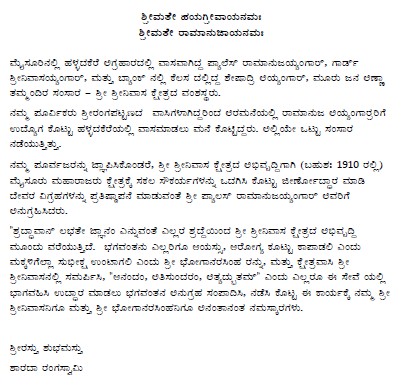
I have some memories of early 1950s when I was taken to the temple. Belagola village had a good 40 feet main road as it was leading to KRS dam. The present road to temple was a typical interior village road and only bullock carts could go. We used to walk from village. No electricity there.
We had a distant relative (I think Sri Gopal Iyengar, related to Sri Ramanuja iyengar, our elder grand father). He lived in paper mill quarters. We used to write a reply post card to him and the archak, a month in advance, requesting the archak to be available for archana when we visit. We used to wait for his reply and then we used to plan our visit. It was something like Amarnath yatra. Later his nephew Sri Venkata Krishna Iyengar became archak there. He had very limited knowledge of temple pooja. My father Sri Anantharama Iyengar used to chant the mantras and the archaka used to do pooja.
At that time, we had to carry or arrange for everything and prasadam. Only river water was there. Devotees used to murmur that temple had good lands of 8 acres and all gone with the connivance of neighboring locals and all !!! They used to say that temple had Garuda kamba and idols of many alwars. Temple had a paka shale & store room, parts of which we can see even now in the back yard. At a time it was even heard that parts of these are in Sampige. However, this information is not authentic.
“Dhaatri Havan” was regularly celebrated in olden days.
After around 1970, none used to visit temple. The grill gates were taken away by miscreants, leaving everything open and abandoned. Temple premises became an “Adda” for mischief mongers to smoke drink gamble and so on. Whenever we visited we could witness cigarette butts, liquor bottles and so on. Archaka had stopped coming. At one time, my father himself, after a bath in kaveri river, performed archana naivedya mangalarati.
There was no pleasure. It used to look like a God fearing ritual for us. Now there is no need to fear. We can love our temple and God. Looks like, worst days have passed and we can hope and pray for better times to come in future.
Balaji SA
24-Jul-2024
References
Click on the link below for the full original paper on
Srinivasakshetra – Antiquity and Architectural Remains
Dr. M.S. Krishna Murthy
Former Professor and Chairman,
UGC Emeritus Fellow DoS in Ancient History and Archaeology,
University of Mysore, Mysore, INDIA

 Sri Srinivasa Kshetra